
 AI Dialogues: Mindfulness & Cultivation
The Revolutionary Essence of the Vimalakirti Sutra
Lay Spirituality, "Afflictions Are Themselves Bodhi," Vimalakirti's Thunderous Silence, and Integration with Master Yongta's Dongsasub & Mubi Bodai
All responsibility for the content, philosophical interpretations, structural organization, and AI dialogue records on this page rests entirely with the page author (creator). These materials are compiled as private research and reflective study notes to explore Master Yongta's profound teachings from multifaceted perspectives. Readers are kindly requested to use this as background reference material. (Author: Page Creator)
[Preamble — Echoes of Master Yongta's Silence in the Stillness of Hamyang]
Years ago, deep in the mountains of Hamyang, South Gyeongsang Province, Korea, at the "Dongsasub Happy Village (Haengbok Maeul)," I had the opportunity to pose a heartfelt question to Great Zen Master Yongta. With bated breath, I waited to hear what profound Dharma gate would open in response. Yet, no matter how much time passed, the Master simply closed his eyes in seated meditation and remained utterly silent. Perplexed, I anchored myself in the spirit of the Master's practical mind cultivation method—"Guna" (Acceptance: "So it is"), "Getji" (Understanding: "There must be a reason"), and "Gamsa" (Gratitude: "Thank you")—known as NAJISA meditation. I reassured myself: "The Master surely has his reasons for not answering. I should be grateful that I was not scolded for asking a foolish question."
A year later, as I was reading the Vimalakirti Sutra, I encountered the famous scene where, following exhausted verbal debates among great bodhisattvas, Vimalakirti revealed the ultimate truth through a silence described as "thunderous silence." At that moment, a flash of insight struck me like lightning: "Ah, the Master's profound silence in Happy Village that day was none other than Vimalakirti's thunderous silence itself!"
This record explores the revolutionary drama of the Vimalakirti Sutra, which dismantles the rigid dogmatism of monastic elites; the dynamic paradox that true lotuses bloom only in dirty mud ("Afflictions Are Themselves Bodhi"); Prince Shotoku's historical integration of this wisdom into ancient Japan's governance; and its profound contemporary resonance with Master Yongta's core teachings of Dongsasub (the Fourfold Integration of Bodhisattva Action) and Mubi Bodai (Non-Dual Bodhi / Absolute Affirmation of Daily Existence).
Chapter 1: The Dawn of Revolutionary Lay Buddhism — The 14 Chapters and Three-Act Drama of the Vimalakirti Sutra
【Question 1】 "What kind of scripture is the Vimalakirti Sutra? How does it fundamentally differ from standard Buddhist sutras, and what is its overarching narrative structure?"
✦ Gemini's Exposition 1
The Vimalakirti Nirdesa Sutra is one of the most dynamic, humorous, and celebrated masterpieces born from the early Mahayana Buddhist movement.
While traditional sutras typically open with "Thus have I heard" and feature the historical Buddha preaching to monks, the defining brilliance of the Vimalakirti Sutra is that its central protagonist is not an ascetic monk, but Vimalakirti, a wealthy lay householder and intellectual living in the cosmopolitan city of Vaishali. The text unfolds as an electrifying dramatic play.
✦ Vimalakirti (The Incorruptible Lay Bodhisattva)
A prominent householder who maintained a family, engaged in commerce and civic politics, and mingled in secular society, yet remained untainted by worldly attachments. Endowed with transcendent wisdom and boundless compassion, he personified the archetype of the living lay Bodhisattva, surpassing even the most eminent monastic elders.
Translated into Chinese by Kumarajiva in 14 chapters across 3 fascicles, the entire sutra unfolds in a brilliant three-act dramatic arc:
-
[Act 1: Prologue and Entrance of the Hero] (Chapters 1–3)
The Buddha preaches that when the mind is pure, the Buddha-land itself is pure (Purification of the Buddha-field). In Vaishali, Vimalakirti feigns illness as a skillful means (Upaya) to teach visitors the impermanence of the physical body. When the Buddha asks his chief monastic disciples (including Shariputra, the foremost in wisdom) to visit Vimalakirti, every single disciple cowers and refuses, recalling past encounters where Vimalakirti shattered their rigid dualistic dogmas. -
[Act 2: The Battle of Wits and Miraculous Awakening] (Chapters 4–9: The Climax)
Even great bodhisattvas such as Maitreya hesitate, until Manjushri, the embodiment of transcendent wisdom, accepts the mission. In Vimalakirti's modest ten-foot-square room, the inquiry begins with the immortal declaration: "Because all sentient beings are sick, I too am sick." The room expands infinitely to accommodate celestial lion thrones; a heavenly maiden scatters flowers to expose Shariputra's subtle clinging and switches genders with him; Vimalakirti reveals that the lotus blooms only in the mud ("Afflictions Are Themselves Bodhi"); and the chapter culminates in the thunderous silence of the Gate of Non-Duality. -
[Act 3: Epilogue and Confirmation of Truth] (Chapters 10–14)
Fragrant food is manifested from distant realms to nourish the assembly, and Vimalakirti's past celestial origin is unveiled, demonstrating the dynamic malleability of reality. The Buddha praises the inexhaustible merit of the teaching and entrusts it to future generations.
The foundational message running through the Vimalakirti Sutra is an empowering humanistic manifesto: one does not need to abandon the world or hide in mountain monasteries to attain supreme enlightenment; living fully and consciously in the very midst of everyday worldly afflictions is itself the supreme path of the Buddha.
Chapter 2: The Lotus Blooms Only in the Fertile Mud — "Afflictions Are Themselves Bodhi" and the Non-Duality of Ice and Water
【Question 2】 "Could you elaborate on the core Mahayana paradox presented in the sutra: 'Afflictions Are Themselves Bodhi' (Klesha is Bodhi)? Why can the turbulent mud of desire and worldly friction become the direct ground of enlightenment?"
✦ Gemini's Exposition 2
The supreme paradox of Mahayana Buddhism is articulated with unforgettable power in Chapter 8 (The Bodhisattva Path): "Afflictions Are Themselves Bodhi" (煩悩即菩提 / Klesha is Bodhi). Vimalakirti delivers a sharp critique against the ascetic ideal that seeks liberation through the sterile eradication of human emotion and secular life.
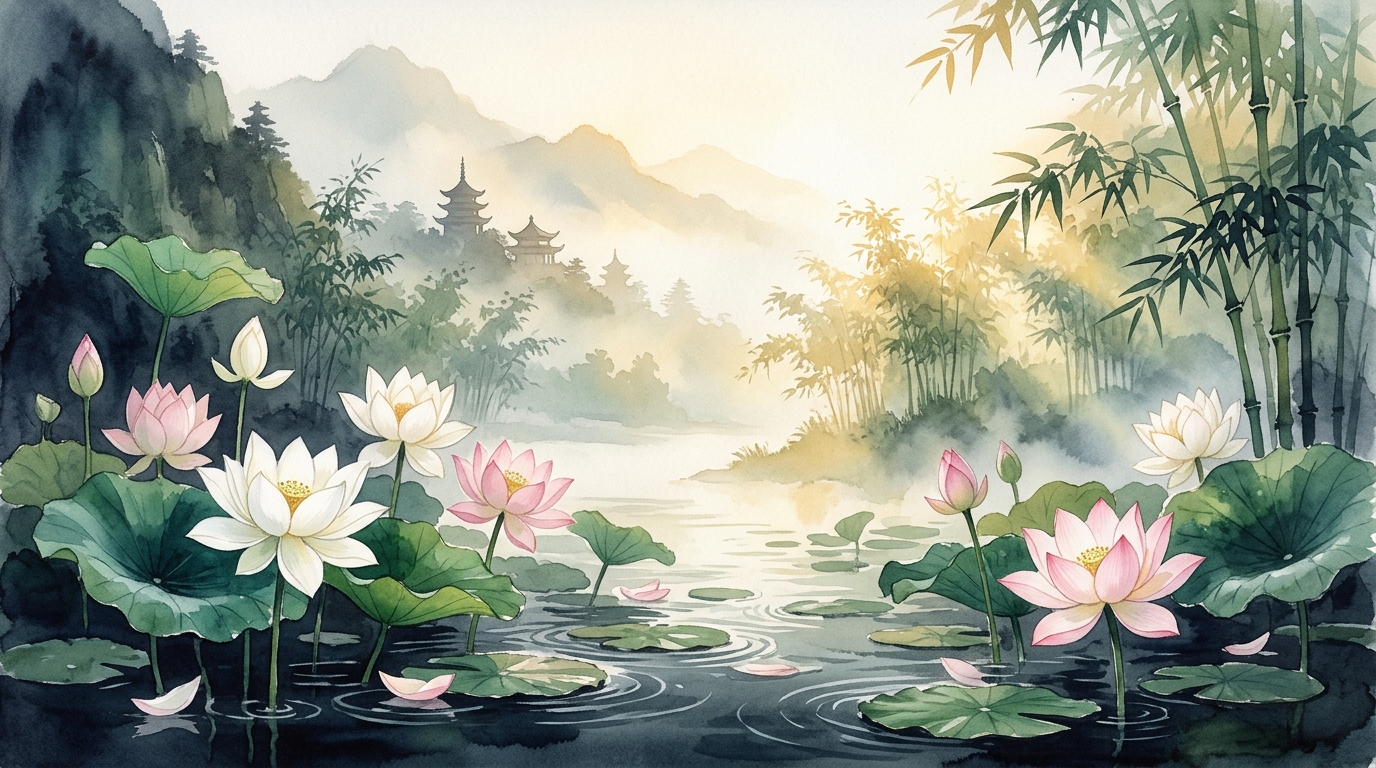
"The lotus flower does not grow on the high dry plateau; it is only in the low, swampy, and fertile mud that the lotus blossoms forth." — Vimalakirti Nirdesa Sutra, Chapter 8
This poetic metaphor conveys three fundamental truths of radical non-duality:
-
The Contrast of High Plateaus vs. Swampy Mud
The "high dry plateau" symbolizes the sterile, risk-free zone of the ascetic who detaches from human relationships to preserve personal peace. The "swampy mud," by contrast, represents the raw, messy reality of everyday society—with all its conflicts, attachments, grief, and desires. From an aseptic vacuum, no great compassion (the lotus of universal salvation) can ever be born. It is precisely when one immerses oneself into the mud of human suffering that the radiant flower of genuine awakening blooms. -
The Non-Duality of Ice and Water
Common thinking divides reality into "afflictions = bad, to be eradicated" and "enlightenment = good, to be attained." The Vimalakirti Sutra penetrates this duality by showing that afflictions and Bodhi are like ice and water. Ice is merely frozen water; when warmed by the heat of wisdom and awareness, the ice melts back into fluid water. If you pulverize and discard the ice, you destroy the water as well. The practice is not about annihilating mental energy, but transmuting rigid delusion into flowing compassion. -
"Walking the Non-Way to Attain the Buddha-Way"
Vimalakirti introduces an audacious mode of being: entering worldly taverns, navigating political turmoil, and walking through profane places. This is not self-indulgence; it is the ultimate skillful means (Upaya) to meet suffering beings at eye level. One cannot heal the brokenhearted from an elevated throne of moral superiority; true Bodhisattva compassion demands standing in the very same mud.
- Stance: Extinguish mental defilements (Extinction of Body and Mind)
- Ideal Realm: High dry plateau (Sterile, safe retreat)
- Dualism: Defilement (Impure/Evil) vs. Nirvana (Pure/Good)
- Limitation: Struggles to generate active compassion for society
- Stance: Immediate transmutation (Afflictions are Bodhi / Ice is Water)
- Ideal Realm: Swampy fertile mud (The raw heart of worldly life)
- Non-Dualism: Delusion's essence is empty; it fuels the awakening fire
- Fruit: Magnificent white lotuses of universal compassion blossom
"Afflictions Are Themselves Bodhi" is neither nihilism nor moral complacency. It is an invigorating, positive affirmation: do not flee from your human vulnerabilities; recognize them as the irreplaceable spiritual soil from which boundless empathy and wisdom arise.
Chapter 3: The Heavenly Maiden's Witty Parody — Shattering Monastic Attachments and Gender Dualism through Śūnyatā
【Question 3】 "The exchange between the Heavenly Maiden and Shariputra in Chapter 7 is renowned for its wit. How does she disarm the foremost intellectual of the monastic order, and what essential truths does this parody reveal?"
✦ Gemini's Exposition 3
Chapter 7 (Viewing Sentient Beings) features the most humorous, subversive deconstruction of institutional rigidity in all of Buddhist literature: the drama of the Heavenly Maiden (Deva-kanya) and Shariputra.
Moved by the profound dialogue between Manjushri and Vimalakirti, a heavenly maiden residing in the room showers celestial blossoms over the gathering. When the blossoms touch the great bodhisattvas, they slide effortlessly off their robes to the floor. However, when they land on Shariputra—revered as the foremost among the Buddha's disciples in analytical intellect—the flowers cling tightly to his robes and will not detach.
Under monastic vinaya (precepts), adorning oneself with fragrant blossoms is strictly forbidden for an ordained monk. Panicked, Shariputra begins brushing, shaking, and swatting at his robes. Watching him struggle, the Heavenly Maiden addresses him with an amused smile:
Heavenly Maiden: "Venerable Shariputra, why do you labor so frantically to shake off these gentle flowers?"
Shariputra: "These flowers are inappropriate for a monk. They violate the monastic code; therefore, I must remove them."
Heavenly Maiden: "Do not blame the flowers. Flowers possess no dualistic notion of 'pure' or 'impure.' The clinging exists entirely within your own discriminating mind. The bodhisattvas are free from mental bias; hence, the flowers fall away naturally. You, however, fear the flowers as impure secular contamination. It is your anxious aversion that clings to them!"
✦ The Clinging of Aversion
The maiden points directly to a profound psychological trap: obsessive aversion toward secular defilement is itself a form of grasping. When we reject the world out of fear of losing purity, our very rejection binds us to the object of our fear.
Cornered, Shariputra resorts to the societal prejudice of his era, asking: "If your wisdom is so extraordinary, why do you remain in the inferior form of a woman rather than transforming into a man?"
Instantly, the Heavenly Maiden uses her supernatural power: she transforms Shariputra into her own female form, while she assumes Shariputra's male monastic appearance!
Shariputra (trapped in a female body): "How... how have I become a woman?!"
Heavenly Maiden (in Shariputra's form): "Venerable Shariputra, does your present female form possess any absolute, inherent reality? In ultimate Emptiness (Śūnyatā), all phenomena are beyond 'male' or 'female.' You are clinging to transient appearances. Now, while residing in that female body, please feel free to debate the inferiority of women with me!"
Through this brilliant comic inversion, the sutra exposes two crucial insights: first, that an obsession with ritual purity is merely subtle cowardice; and second, that social hierarchies—gender, monastic versus lay, sacred versus profane—are arbitrary mental constructs devoid of inherent self-nature.
Chapter 4: Vimalakirti's Thunderous Silence — The Dharma Gate of Non-Duality Beyond All Words
【Question 4】 "In Chapter 9 (Entering the Dharma Gate of Non-Duality), Vimalakirti remains completely silent. Why is this wordless stillness celebrated throughout Zen history as 'a silence like thunder'?"
✦ Gemini's Exposition 4
Following the Heavenly Maiden's lesson, the narrative ascends to its supreme philosophical climax in Chapter 9: The Dharma Gate of Non-Duality (入不二法門) and Vimalakirti's Thunderous Silence.
Vimalakirti asks the thirty-one bodhisattvas gathered in his room: "Noble ones, how does a bodhisattva enter the non-dual truth that transcends all opposition? Please express your realization."
- "To see birth and death as two is duality. Knowing that all dharmas are originally unborn, there is no death."
- "To see purity and impurity as two is duality. Seeing that impurity's nature is empty, the clinging to purity dissolves."
- "To distinguish between sin and merit is duality. The self-nature of transgression is empty, no different from merit."
Each bodhisattva offered an impeccable philosophical definition of Emptiness. Finally, Manjushri, the foremost in wisdom, evaluated their responses and pushed the realization further:
"All of your explanations are magnificent. Yet, you are still employing words and conceptual symbols. To truly enter non-duality is to have no words, no explanation, no designation, no conceptual consciousness—leaving behind all questioning and answering entirely."
Manjushri's insight was penetrating: the moment you speak of "non-duality," you introduce a speaker and a listener, thereby recreating the very dualism you seek to transcend. Having spoken, Manjushri turned to Vimalakirti:
"Now, Vimalakirti, we have all spoken. How do you declare that a bodhisattva enters the non-dual truth?"
The entire room fell motionless. Everyone leaned forward to catch what ultimate revelation would issue from Vimalakirti's lips.
—And Vimalakirti uttered not a single word. He did not move; he did not gesture; he sat in absolute, boundless stillness.
✦ Silence Like Thunder (維摩一黙 如雷)
While Manjushri used words to declare that words are inadequate, Vimalakirti embodied the wordless ground itself. Manjushri bowed in awe: "Marvelous, truly marvelous! This is the true entry into non-duality, where not a single syllable or concept can abide."
This "Silence Like Thunder" is not blank stupor or passive evasion. It is the roaring presence of unmediated Reality. In a single sweep, it shatters the restless ego-mind that incessantly categorizes life into right and wrong, profit and loss, friend and foe.
Chapter 5: Echoes in Ancient Asuka — Prince Shotoku's Commentary and the Spirit of Harmony in the Seventeen-Article Constitution
【Question 5】 "Prince Shotoku of 7th-century Japan authored the Yuimagyō-gisho (Commentary on the Vimalakirti Sutra). How did he adapt 'Afflictions Are Themselves Bodhi' and Vimalakirti's silence into Japan's foundational statecraft and the Seventeen-Article Constitution?"
✦ Gemini's Exposition 5
When the Vimalakirti Sutra crossed East Asia and arrived in 7th-century Asuka-period Japan, it was embraced by Prince Shotoku (Shotoku Taishi), the founding statesman of classical Japan, who transformed its lay metaphysics into a practical philosophy of national integration.
Amid violent tribal conflicts between the Soga and Mononobe clans, Prince Shotoku recognized that an ethereal monasticism divorced from political reality could not heal a fractured society. As regent, statesman, husband, and father, Shotoku found his guiding mirror in Vimalakirti—a householder navigating the raw, treacherous tides of civic power without losing his enlightened center.
The spirit of Shotoku's commentary, the Yuimagyō-gisho, directly breathes through Japan's first constitutional code, the Seventeen-Article Constitution (604 CE):
-
Article 1: "Harmony is to be valued, and an avoidance of wanton opposition to be honored."
"Harmony" (和 / Wa) here is not superficial conformism. Just as the lotus blooms from the muddy swamp, Shotoku recognized that human beings are inherently flawed, ego-driven beings. True harmony means embracing diverse, imperfect individuals and integrating their friction into a cohesive social blossom. -
Article 10: "Cease from wrath, and refrain from angry looks... Nor are we necessarily sages, nor are they necessarily fools. Both of us are simply ordinary mortals (Bonbu)."
This article directly embodies the non-dual dismantling of self-righteousness. "I am not always right, nor is the other always wrong; we are both fallible mortals." This radical humility dissolves moral superiority and the illusion of absolute dualistic judgment. -
Article 17: "Decisions on important matters should not be made by one person alone. They should be discussed with many."
Just as Vimalakirti demonstrated the limitations of any single verbal formulation, Shotoku warned against autocracy. Because all human perspectives are partial, collective dialogue must be reverenced. Vimalakirti's silence inspired Shotoku to cultivate the quiet humility necessary to truly listen to others.
Prince Shotoku did not treat the Vimalakirti Sutra as an abstract library treatise. He transplanted its fertile seeds into the soil of a young nation, using it to build a culture grounded in empathy, dialogue, and communal harmony.
Chapter 6: Contemporary Awakening: Dongsasub and Mubi Bodai — Integrating Master Yongta's Spiritual Practice with "Afflictions Are Themselves Bodhi"
【Question 6】 "How do Master Yongta's Dongsasub (Fourfold Integration of Bodhisattva Action) and his core teaching of Mubi Bodai (Non-Dual Bodhi) harmonize with the Vimalakirti Sutra? What practical guidance do they offer for modern daily life?"
✦ Gemini's Exposition 6
The personal experience shared in the Preamble—witnessing Master Yongta's profound silence in Hamyang Happy Village—illuminates how the ancient wisdom of Vimalakirti has been revitalized in our modern era through Master Yongta's teachings of Dongsasub and Mubi Bodai.
By examining the deep congruence between these traditions, a clear map emerges for transmuting modern anxiety into serene awakening.
- "Because beings are sick, I am sick": Taking others' suffering as one's own
- Afflictions Are Bodhi: Mud is directly transmuted into the lotus flower
- Vimalakirti's Silence: Striking down mental duality with thunderous stillness
- Dongsasub: Unifying self and other to share joys and sorrows intimately
- Mubi Bodai: Absolute affirmation that all phenomena are the manifestation of Bodhi
- Master's Silence: Dissolving distractions into "Guna, Getji, Gamsa" (NAJISA)
-
Dongsasub and "Because Beings Sicken, I Sicken"
Among the Four Bodhisattva Integrations (Giving, Loving Speech, Beneficial Action, and Empathic Integration / 同事攝), Master Yongta placed Dongsa (becoming one with the other) at the heart of modern mind training. Just as Vimalakirti absorbed the illness of his fellow citizens into his own heart, Dongsasub is the practice of stepping into another's shoes, feeling their agony and joy as your own, and dissolving the illusion of separation. -
Mubi Bodai and the Absolute Affirmation of "Afflictions Are Bodhi"
Master Yongta frequently proclaims Mubi Bodai ("There is nothing that is not Bodhi"). Rooted in the Complete Enlightenment Sutra and the Vimalakirti Sutra, this is the radical realization that every sensation, agitation, or sorrow is already the dynamic expression of Buddha-nature. Instead of fighting anxiety or anger as enemies of meditation, one embraces them: "This agitation too is the living pulse of Bodhi." Transmuting resistance into total acceptance instantly converts inner friction into pure spiritual fuel. -
The Master's Silence and the Power of NAJISA Meditation
When Master Yongta met the seeker's conceptual inquiry with silence, he severed the ego's addiction to intellectual commentary. He gently brought the seeker home to the living reality of the here and now. This is made tangible through Master Yongta's celebrated three-step heart formula: NAJISA Meditation (구나, 겠지, 감사):- "~Guna" (~구나 / "So it is!") [Acceptance]: Ceasing resistance and accepting the unfolding situation and emotions exactly as they are (Non-Dual Acceptance).
- "~Getji" (~겠지 / "There must be a reason") [Empathy & Understanding]: Recognizing that the other person has their own history, pain, and perspective, viewing them with warm understanding (Dongsasub Empathy).
- "Gamsa" (감사 / "Deep Gratitude") [Transcendence & Blessing]: Celebrating all encounters and difficulties as precious lessons in awakening and dedicating merit to all life (Mubi Bodai & Compassionate Dedication).
✦ Conclusion: The White Lotus Blooming in Today's Mud
We do not need to journey to distant mountains or ancient sanctuaries in search of a sanitized holy land. The workplace tensions, domestic chores, and complex relationships of our modern daily lives are the fertile mud from which our awakening must blossom. When we plant our roots deeply in the soil of daily life, practice Dongsasub by embracing others as ourselves, and greet each arising moment with a smile of Mubi Bodai, our own ten-foot room fills with the thunderous silence of Vimalakirti and the boundless peace of a living Buddha.